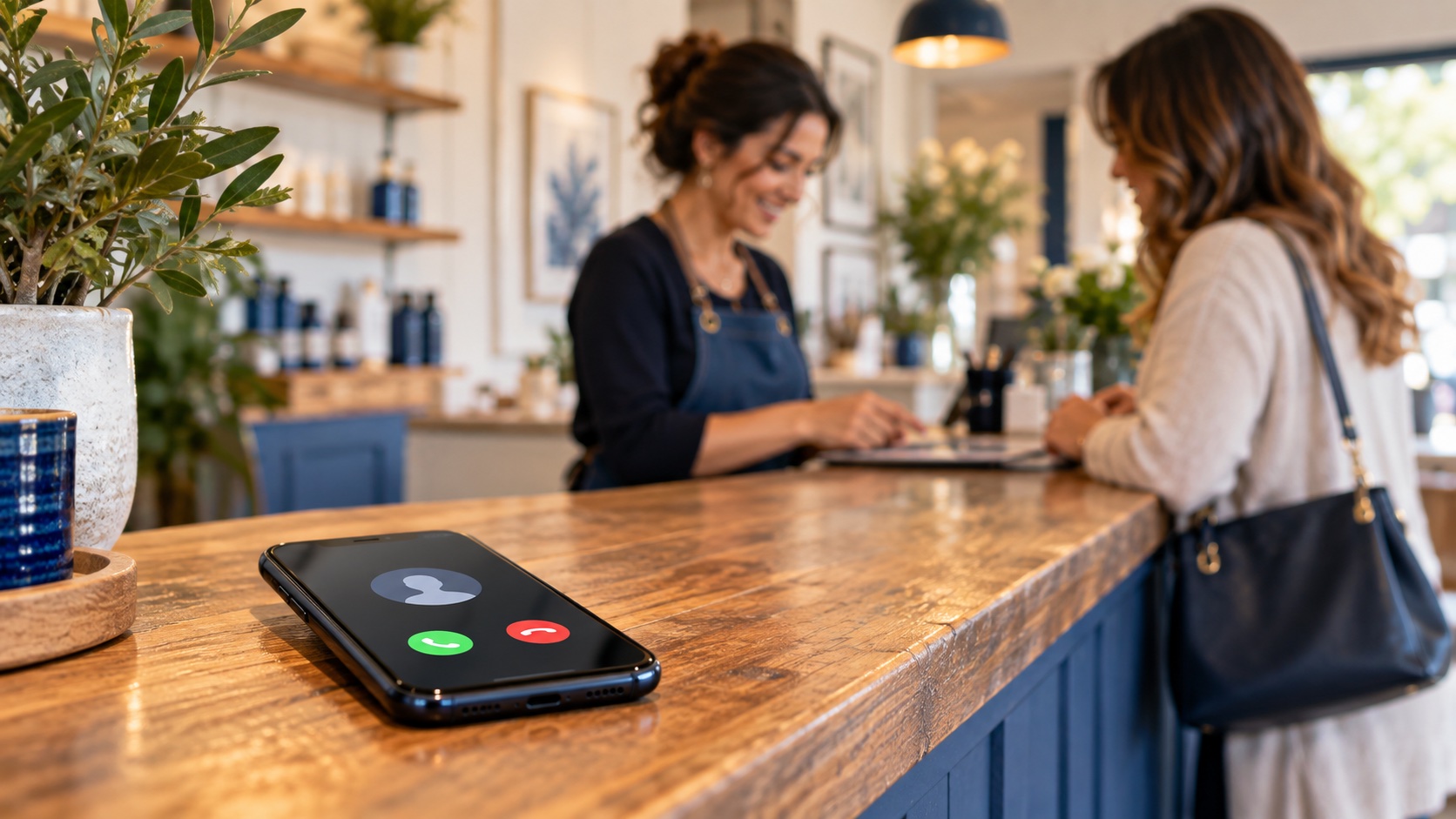
Short answer: every call you don't answer is a customer who probably calls the next business on the list. To find out how much that costs you, multiply your missed calls per month × the percentage that normally turns into a sale × what an average sale is worth. For many small businesses, the result is hundreds or thousands of dollars a month. The good news: there are now affordable ways to answer 100% of calls, even at night and in Spanish.
In this article you'll find:
- A simple formula to calculate how much you're losing
- How to measure your missed calls this very week
- A comparison of 4 options (with approximate costs)
- How an AI receptionist works, and what it can and can't do
Why small businesses miss so many calls
If you run a restaurant, a salon, a shop, or a service business, this has probably happened to you:
- You're helping a customer in person and the phone rings.
- You're on a job site, driving, or your hands are full.
- It's the busiest hour and no one can pick up.
- The call comes in at 9 PM or on a Sunday.
The problem isn't that you don't want to answer. It's that one person can't be in two places at once. And the person calling usually has an immediate need: they want an appointment, a price, or to know if you're open today. If no one answers, they don't wait — they search for another option on Google.
Calculate how much not answering is costing you
Use this formula:
Missed calls per month × % that convert into a customer × average sale value = money you let go every month
Example: a beauty salon
- Misses 5 calls a week (about 20 a month)
- Normally 1 in 3 calls turns into an appointment
- An average appointment is worth $60
20 × 0.33 × $60 = about $400 a month, or nearly $4,800 a year. And that's without counting customers who would have come back again and again.
Do the math with your own numbers
| Business type | Missed calls/mo | % that convert | Average sale | Approx. loss/mo |
|---|---|---|---|---|
| Beauty salon | 20 | 33% | $60 | ~$400 |
| Restaurant (orders/reservations) | 40 | 50% | $35 | ~$700 |
| HVAC / plumbing | 10 | 40% | $350 | ~$1,400 |
These numbers are examples to illustrate the math. Swap in your own: the real result could be higher or lower.
For home-service businesses, where a single call can be worth hundreds of dollars, missing even a few calls a week already adds up to real money.
How to find out how many calls you're missing (in 1 week)
You don't need to guess. Check these sources:
- Your cell phone or business line's call history. Count the calls marked "missed" over 7 days.
- Your phone carrier's portal. Many show incoming and unanswered calls by date and time.
- Your Google Business profile. The performance section shows how many people called from Google.
- Note what time calls get missed. If most happen during your busiest hour or after hours, you already know where the problem is.
At the end of the week, multiply by 4 and you'll have your monthly number for the formula.
What about voicemail? Why it isn't enough
Voicemail looks like a solution, but it has three problems:
- Many customers hang up without leaving a message and call another business instead.
- You call back hours later, by which point the customer already went with someone else.
- It doesn't book anything. You still have to return the call, coordinate a time, and write it down.
It works as a last resort, but it doesn't turn calls into customers.
4 ways to stop missing calls (comparison)
| Hiring a receptionist | Answering service (call center) | Voicemail | AI receptionist | |
|---|---|---|---|---|
| Approximate cost | Salary + payroll taxes (easily over $2,500/mo full-time) | $0.75–$1.50 per minute; many plans run $200–$2,000+/mo* | Free or included | From ~$25 up to $300/mo on platforms; custom setups add an upfront fee + monthly |
| Hours | Only their shift | 24/7 (sometimes with an after-hours surcharge) | 24/7 | 24/7 |
| Spanish & English | Depends on the person | Depends on the provider | — | Yes, and can switch languages mid-call |
| Books appointments | Yes | Sometimes | No | Yes, directly on your calendar |
| Knows your business | Very well | With a basic script | No | With the information you give it |
| Best for | Businesses with a lot of in-person volume | Businesses that always want a human | Very low call volume | Small businesses missing calls because they're busy or after hours |
*Approximate ranges based on pricing guides published by industry providers in 2026. Prices vary a lot by volume and provider.
There's no single "right" option for everyone. If your business gets few calls and someone's always free, you may not need anything. But if you're missing calls every week, an AI receptionist is usually the cheapest way to answer all of them.
How an AI receptionist works (step by step)
- A call comes in on your usual number (or gets forwarded when you don't answer).
- The AI answers within seconds, in Spanish or English, with your business's name.
- It answers common questions: hours, prices, location, services.
- It books the appointment directly on your calendar (Google Calendar, for example).
- It sends a confirmation message to the customer.
- It sends you a summary of every call: who called, what they wanted, and what was agreed.
Here's what a real call sounds like:
Customer: Hi, do you have an opening tomorrow for a haircut?
AI: Absolutely! I have 9:00 or 11:30 available. Which works better?
Customer: 9:00, please.
AI: All set, Maria. I'll text you the confirmation. See you then!
What the AI doesn't do (on purpose)
- It doesn't replace your personal touch. If the call gets complicated or the customer asks for you, it transfers the call or leaves you the message.
- It doesn't make up information when set up properly: it only answers with the details you give it.
- It's not for everything. Emergencies, sensitive complaints, or big negotiations should reach you directly.
How much does it cost to set up?
It depends on what you need. At EM Tech, the AI Receptionist costs from $499 USD setup + from $99 USD a month, with a fixed price I tell you upfront and no long contracts. It includes:
- Answering calls and booking on your calendar
- Automatic message for missed calls
- A summary of every call
- Setup in Spanish and English with your business's information
If your calculation above shows you're losing more than $100 a month in calls, it usually pays for itself.
Checklist before hiring any solution
- Does it answer in Spanish and English?
- Does it connect to your calendar, or just take messages?
- Can you listen to or read each call afterward?
- Can it transfer the call to you when needed?
- Is the price fixed, or does it charge per minute with extra fees?
- Is there a long contract, or can you cancel month to month?
- Who sets it up and maintains it: you or the provider?
Frequently asked questions
Will my customers notice it's an AI?
Today's voices sound very natural. Even so, we recommend being transparent: the AI can introduce itself as "[your business]'s assistant." Most customers care more about getting a fast answer and getting their issue solved.
Do I have to change my phone number?
No. Usually a call-forwarding rule is set up: when you don't answer (or you're after hours), the call goes to the AI receptionist.
Does it work for restaurants, salons, and home services?
Yes. These are some of the most common cases: reservations and orders, appointments and reminders, or service requests and quotes.
What happens if a customer asks something the AI doesn't know?
It takes the customer's details and lets you know so you can call them back, or transfers the call to you if you're available.
How long does it take to get set up?
A typical project takes 1 to 3 weeks, depending on how many integrations you need (calendar, messaging, CRM).
Want to know how many calls your business is missing?
I'll help you run the math with your own numbers in a free 30-minute consultation. I'll tell you whether an AI receptionist makes sense for you and how much it would cost, no commitment.